Control Issues

This has been a day of weirdness.
It began after lunch with finding an unopened bottle of SmartWater next to a drinking fountain at a doctor’s office. By itself, that’s a minor non sequitur. Something I could chuckle at and report on Facebook. Then, late in the afternoon, while on my way to a downtown appointment, I found myself behind a late-model car being driven by a man who was behaving even more weirdly than other Seattle drivers.
The elderly fellow was rolling slowly along in the second lane of northbound 99 on the Viaduct. I’m pretty sure he was hoping to change to the right lane, which becomes the only exit from 99 into downtown Seattle. However, every time he started to move to the right his windshield wipers switched on, leading to his jerking the car back into the second lane. Each time he returned to the second lane his windshield wipers switched off. After several aborted attempts, he ran out of room to make the lane change, so he continued north. He had not once used his turn signal. It was not raining.
I’d like to find this hilarious. I can’t because I realize how difficult it is for me to remember which dials on my stove control which burners and what the login password is on my computer. I’m not old, though that shouldn’t make a difference. I’m intelligent. I pay attention. Nonetheless, some things just don’t stick in my memory. My father was the same. The only way he could find his little brown car in a parking lot was to try his key in the doors of one car after another until he found a door that opened. But he wasn’t weird. Neither am I. I’m not that man who can’t figure out his turn signal lever.
Please let me laugh. I really want to laugh. What would Jesus do? What would John Stewart do?

Oct. 23, 2012
Busy Signals

A green traffic light means go.  A red traffic light means stop.  It’s the same here in Seattle as everywhere else–except in the turn-lanes.
In Seattle a green turn-arrow means put your coffee cup down, adjust your mirror, check what the car behind you is doing, check the GPS to make certain you should be turning at this intersection, check what the car in front of you is doing, note the price of gasoline at the station across the street, SQUIRREL!, put your lipstick or electric razor down (or both), note that the car in front of you has cleared the intersection and is half-way down the next block, signal your intention to execute a turn, put your car in gear, check what the dog at the hydrant is doing, note that the turn arrow has changed from green to amber to red, slowly depress the accelerator pedal and proceed carefully through the intersection while disregarding the honking horns and angry curses.  So it will go, whether you are the first or tenth car in line.
In the through lanes, on the other hand, you will smash the accelerator pedal to the floor the instant the light turns green, race through the intersection, and blow your horn and curse at all the slow drivers in the turn-lane.
In short, if you live in Seattle, you will exhibit both behaviors and you will think nothing of the difference.


Aug. 24, 2012

Bridges


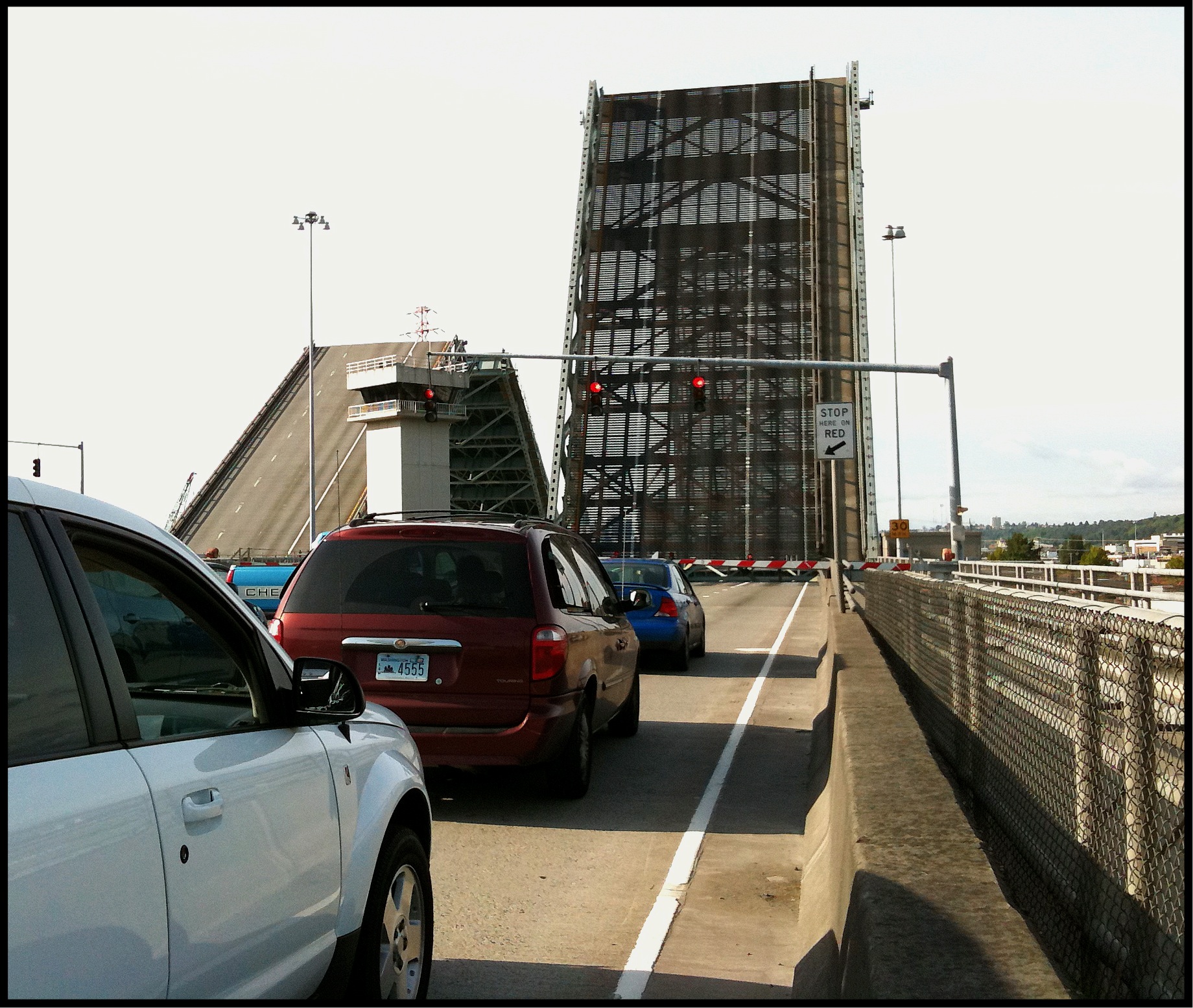
Seattle’s First Avenue South drawbridge needs only small electric motors to open and close for ship traffic on the Duwamish River. It opened this evening as I raced toward it on my way to the driving range. I should have remembered the bridge operator senses my impatience and tight schedules.
When the bridge opens and car traffic stops, most drivers remain in their seats with their engines idling. But some of us veterans prefer to shut our engines and radios off and get out to stretch our legs. As I strolled to the bridge railing to photograph the silently rising deck, the driver of a nearby SUV walked over to greet me.
“You want see two roast pigs?” he asked in broken English.
He was a small Filipino man with front teeth missing from his broad smile. He asked again.  “You want see my roast pigs?”
“Sure!” I answered.
I have this experience often. Strangers introduce themselves as if my face has the shape of a friendly question mark.  The man led me to the back of his SUV and lifted the hatch. Lying side by side on the floor in two long, foil-lined boxes were two perfectly browned pigs, stretched out like supplicants before an alter. Despite the context of stopped traffic on a busy American highway, they looked shockingly beautiful. Rather than dead, they looked proud and sanguine, as if they had volunteered from their herd.
“They for a christening,” the man said as he adjusted the foil near the plump snout of the pig on the left.
“A christening? That’s wonderful. Congratulations!” I told him as I held out my hand. But the man stepped back a little, explaining, “Oh, no. The pigs, they not for me; they for a friend. Whenever there a christening, everybody ask me roast pigs for them.”
I held out my hand once more. “Please, offer your friend my congratulations.”
This small re-direction made all the difference. The man vigorously shook my hand, saying happily, “Thank you very much!  I tell him.”
As the drawbridge began to close, he shut his hatch, smiled once more, and returned to his driver’s seat. I waved to him and returned to my car. The two halves of the heavy bridge united, returning patience and order to the road.
I didn’t know the man I met. Yet, I understood the meeting. Two small motors can move two thousand tons of steel, but two small pigs can move two thousand years of faith.


June 26, 2011