Control Issues

This has been a day of weirdness.
It began after lunch with finding an unopened bottle of SmartWater next to a drinking fountain at a doctor’s office. By itself, that’s a minor non sequitur. Something I could chuckle at and report on Facebook. Then, late in the afternoon, while on my way to a downtown appointment, I found myself behind a late-model car being driven by a man who was behaving even more weirdly than other Seattle drivers.
The elderly fellow was rolling slowly along in the second lane of northbound 99 on the Viaduct. I’m pretty sure he was hoping to change to the right lane, which becomes the only exit from 99 into downtown Seattle. However, every time he started to move to the right his windshield wipers switched on, leading to his jerking the car back into the second lane. Each time he returned to the second lane his windshield wipers switched off. After several aborted attempts, he ran out of room to make the lane change, so he continued north. He had not once used his turn signal. It was not raining.
I’d like to find this hilarious. I can’t because I realize how difficult it is for me to remember which dials on my stove control which burners and what the login password is on my computer. I’m not old, though that shouldn’t make a difference. I’m intelligent. I pay attention. Nonetheless, some things just don’t stick in my memory. My father was the same. The only way he could find his little brown car in a parking lot was to try his key in the doors of one car after another until he found a door that opened. But he wasn’t weird. Neither am I. I’m not that man who can’t figure out his turn signal lever.
Please let me laugh. I really want to laugh. What would Jesus do? What would John Stewart do?

Oct. 23, 2012

Cruis’n For A Bruis’n

MV Tillikum

MV Tillikum (Photo credit: Wikipedia)

If you’re in your little wooden cabin cruiser, threading your way through the shipping lanes of Puget Sound, and you suddenly hear five short, loud blasts from a ship’s horn, you should infer the possibility that every part of your boat, from stem to stern, is in imminent danger of being destructively dissected by the metal hull and propeller of a large ship whose path you are nonchalantly crossing.
In other words, you should wake the hell up!  If you do nothing to head off this destructive embrace of wood and steel–if you’ve deserted the helm to have a crap, mix a vodka tonic, or become a member of the seamen’s version of the mile-high club–you’ll be offered just one more series of five blasts from the metal monster before it has your life for lunch.

I was on the MV Tillikum‘s passenger deck when I heard five horn blasts from her wheel house.  I’ve heard this warning signal only a couple of times in all the years I’ve ridden car ferries around the Sound. None the less, I went back to fiddling with my camera and watching my daughter read a book.
Then I heard the same warning blasts from another ferry, followed by a second warning from the Tillikum, followed by yet another warning from the other ferry.  That got my attention.  I jumped up and dashed to the Tillikum’s forward observation deck just as she hit the brakes.  (A three-hundred foot ship doesn’t really have brakes, which is the reason it’s vitally important to heed warning signals from ships‘ horns.)
About a thousand feet ahead and a little to port was a medium size pleasure cruiser intent on crossing the Tillikum’s bow.  It had just crossed the bow of the other ferry, which was sailing from the opposite direction.  Both ferries came to a full stop as the small boat’s captain finally realized the pickle he was in and cut his engine.  Unfortunately, I didn’t have my telephoto lens, so I couldn’t tell whether or not the fellow had pants on.
After a long minute of everyone waiting for Godot, the Tillikum and the other ferry resumed their original courses, leaving the small boat’s captain to fend for himself in their intersecting wakes.
I wouldn’t be surprised if the guy put his boat up for sale as soon as he arrived back at the dock.  There is no bowel movement, cocktail, or sex worth the risk of having that experience twice.

July 19, 2012

What?

I visited Goodwill this evening to buy some toy dolls (another story; but trust me, I needed some toy dolls). Ahead of me in the checkout line was a baggy old man wearing baggy old clothes and a beat-up set of headphones.
When the cashier finished ringing up the old man’s purchase, she told him the total, “Four dollars and ninety-two cents, please.” The old man asked, “What?” The cashier repeated the price. The old man put his left hand near his left headphone and again asked, “What?” The flummoxed cashier again told him the total, “Four dollars and ninety-two cents,” but said it more loudly, leaving out the ‘please’. The old man, appearing frustrated, pulled the left headphone away from his ear and again asked, “What?” Once more the cashier told him the total, “Four dollars and ninety-two cents.”
At this point the old man let the headphone snap back over his left ear and said to the cashier, angrily, “Well, why didn’t you say that the first time!”. He then began to slowly and carefully rummage through his baggy old clothes in search of his wallet, which he finally found in a very strange place, the back pocket of his pants.
Convinced I had been teleported back to the 70’s and Allen Funt was still alive, I looked carefully around the front of the store for hidden cameras. I expected an assistant producer to walk up and hand me a pen and a model release while a TV crew with cameras and sound equipment rushed me from nowhere. No such luck.
What a shame. I would like to have lived through the Seventies again. It may have been a boring decade, but it seemed to last forever. That’s a big plus when you hit your Fifties.

June 26, 2012

The First And Last Stories My Mother Told To Me

My mother was once a nun.  She was not Mother Teresa.  In fact, she was a nun only for a few years and never took her final vows.  In her early twenties she entered a high-walled cloistered convent outside Spokane Washington, joining other young women who, like herself, were seeking relief from secret burdens.  But the quiet habit of my mother’s vows failed to silence the din of her spirit.  She was intelligent, and soon realized as she knelt her afternoons away in silent prayer that her knees were being exercised more than her mind.  So, she left.

I know few details of the long intermission that played between the morning she walked out the quiet doors of that convent and the afternoon, years later, when she walked out the doors of a church with my father and a bouquet in her arms.  I know that typewriters, travel, rivet-riddled B-24s, and a torrid romance with a bomber pilot are pieces of the story of her earlier years.  In a somewhat un-Catholic way she had been around the block.  At the same time, she was quite catholic in her worldview: catholic within the Latin meaning of ‘all embracing’.  She followed the sun and moon from one American ocean to the other, train-splitting the brow of our Continental Divide along her way.  She ended her personal tour of duty where she began, Spokane, where she met and fell in love with a young, handsome English professor who had himself been busy being both catholic and Catholic.

For most women in those days, unfortunately, accepting a Catholic marriage often meant surrendering a truly catholic life.  My mother must have considered our home a convent furnished with a husband, six kids, and a deranged dog.  But it’s hard to keep a good woman down—nor did my good father dare to try.  This woman ruled our roost, as well as all other roosts that weren’t well guarded.  She laughed, shouted, and cried while she drank red wine and rationalized her position.  She cursed Saint Paul and most priests, but she silently surrendered her rosary to Mother Mary.  She also told jokes and stories that often only the local Jesuits would dare to laugh at.

The first story I remember my mother telling to me was about an awkward young novitiate in a cloistered convent.  This young nun-to-be accepted many menial and difficult duties, and she was desperate to impress the other nuns with her dedication and piety.  Indeed, her vow of silence prevented her from complaining.

As one of her daily tasks she cooked and served evening meals to the other nuns.  One particular evening she labored diligently but silently to prepare an especially beautiful casserole.  She prayed that the Mother Superior would finally recognize her sincere dedication and offer her the opportunity to take her final vows, along with a ranking seat at the dinner table.  The young woman was quite anxious as she brought the hot casserole from the kitchen.  She was so anxious that she failed to properly mind her feet as she stepped over the threshold at the dining room entrance.

She tripped!  She watched in horror as her beautiful casserole flew through the air before tumbling across the dinner table and landing in the startled Mother Superior’s lap.  Instinctively the novitiate cried out, “Oh Hell!”  She paused only for a moment before clutching the sides of her short black veil and exclaiming in disbelief, “Oh damn, I said Hell!”  Then, as quickly, “Oh God, I said damn!”  Then, not so quickly, she dropped her hands to her side, turned around, and walked slowly back through the dining room entrance muttering, “Oh shit!  I didn’t really want to be a nun anyway.”

It delighted me to hear my mother tell that story.  I had never heard her use the ‘S’ word in my presence.  Some time later, after she had heard me repeating the story to somebody else, I was severely punished.  My mother seemed not to be able to be catholic and Catholic at the same time.

The last story my mother told to me before she died was about an honest and righteous man.  He was a hard-working man who honored his family and church and was a stout pillar of his community.  His piety, honesty, and hard work eventually earned for him a wealthy life on earth.  At the peak of his wealth, however, he began to reflect on a simple caution his grandmother had uttered to him from her deathbed.  She told him what we’ve all heard many times: “You can’t take it with you!”

Gradually the man gave away his earthly possessions until at the end of his long and righteous life he was a virtual pauper.  After his death he immediately found himself at the bright gates of heaven where smiling Saint Peter waited for him with open arms.

“Welcome, my son!” cried Saint Peter.

“I’m so happy to finally be here!” exclaimed the man.

“Well, you’ve certainly earned your place,” Saint Peter answered.

Then Saint Peter paused.  He looked all around where the man was standing before furrowing his brows quizzically and asking, finally, “So, tell me my son, where’s all your stuff?”

I tended to my mother the evening before she died of cancer.  As her body began to cool, I leaned over her bed, kissed her pale cheek, and whispered into her ear, “I love you, Mom.”  I thought she was unconscious.  But she opened her smiling eyes and said, weakly, “I know.”

You can’t keep a good woman down.

June 26, 2011
Bridges


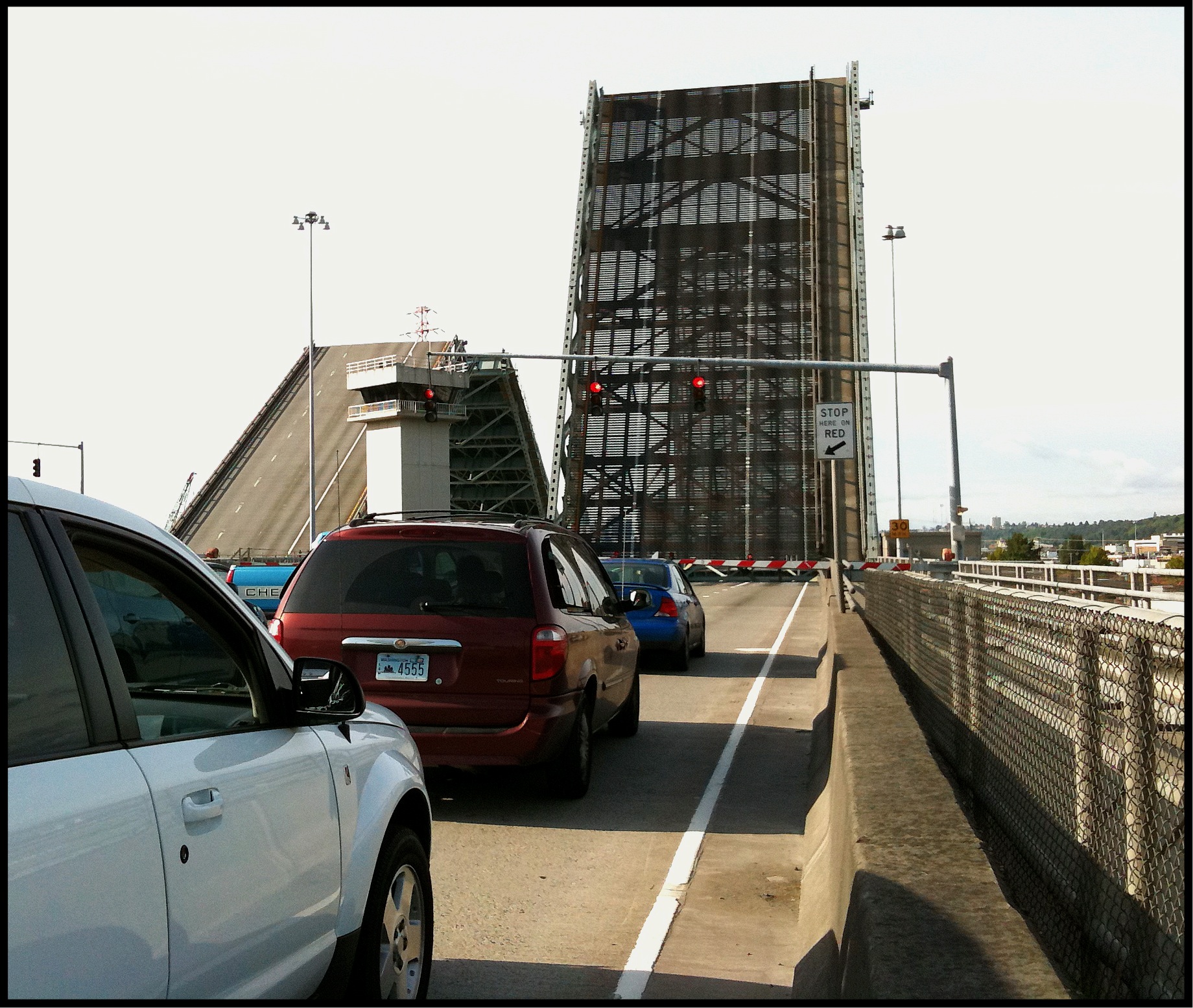
Seattle’s First Avenue South drawbridge needs only small electric motors to open and close for ship traffic on the Duwamish River. It opened this evening as I raced toward it on my way to the driving range. I should have remembered the bridge operator senses my impatience and tight schedules.
When the bridge opens and car traffic stops, most drivers remain in their seats with their engines idling. But some of us veterans prefer to shut our engines and radios off and get out to stretch our legs. As I strolled to the bridge railing to photograph the silently rising deck, the driver of a nearby SUV walked over to greet me.
“You want see two roast pigs?” he asked in broken English.
He was a small Filipino man with front teeth missing from his broad smile. He asked again.  “You want see my roast pigs?”
“Sure!” I answered.
I have this experience often. Strangers introduce themselves as if my face has the shape of a friendly question mark.  The man led me to the back of his SUV and lifted the hatch. Lying side by side on the floor in two long, foil-lined boxes were two perfectly browned pigs, stretched out like supplicants before an alter. Despite the context of stopped traffic on a busy American highway, they looked shockingly beautiful. Rather than dead, they looked proud and sanguine, as if they had volunteered from their herd.
“They for a christening,” the man said as he adjusted the foil near the plump snout of the pig on the left.
“A christening? That’s wonderful. Congratulations!” I told him as I held out my hand. But the man stepped back a little, explaining, “Oh, no. The pigs, they not for me; they for a friend. Whenever there a christening, everybody ask me roast pigs for them.”
I held out my hand once more. “Please, offer your friend my congratulations.”
This small re-direction made all the difference. The man vigorously shook my hand, saying happily, “Thank you very much!  I tell him.”
As the drawbridge began to close, he shut his hatch, smiled once more, and returned to his driver’s seat. I waved to him and returned to my car. The two halves of the heavy bridge united, returning patience and order to the road.
I didn’t know the man I met. Yet, I understood the meeting. Two small motors can move two thousand tons of steel, but two small pigs can move two thousand years of faith.


June 26, 2011


Good Night, Hana

While heading to my bedroom last night, I stopped to check on my daughter. When I stroked her arm, she lifted her head and asked, “Is that you Daddy?”
I told her yes and asked if she was awake.
She answered, “No, but my mouth is.  I probably won’t remember this in the morning.”
I promised to remind her and said, “Good night Hana. I love you.”
As she rolled over she replied, “Good night, Daddy. I love you more.”
Semi-conscious children never lie.


May 6, 2011