Senseless Verisimilitude

image

Harold Edgerton

I am a Harold Edgerton fan, as I am a fan of many deconstructions of common conceptions of time.  It amazes me how an arrangement of silver specks fixed in two dimensions as an image on a sheet of paper can so powerfully inform and misinform us about qualities of all four dimensions (the four we are aware of, at least).  
This Edgerton photograph of a bouncing steel ball is old and imperfect.  Technological advances have since added, exponentially, miraculous qualities of verisimilitude to photographic images.  Yet, as we evermore perfectly photograph reality, by its own rules we create evermore perfect illusions, evermore removed from reality.  
If you held this print in your hands—sensed the ‘ahah!’ dance of steel and time simultaneously measured and on the lam—you might face a new dimension as you turned the print on its edge.  Illusion, reality: where did they go?  What qualities does this object now have that it did not have a moment ago?


Gavin W Sisk
July 23, 2013

Jots and Motes


From last night’s little text messaging bout between my young daughter and myself:

                    Me
Me encanta la pequeña rana en el oido.

                    Hana
You sing a little frog in my ear?

                    Me
Sirenas cantar, pero no mientras Dios susurra.

                    Hana
And how would the sirens know
if God whispered,
aside from being alive?
The sea rolling on itself
every day, striking the rock’s face
and somewhere else drowning a good sun?
We doubt the words were spoken.
But where bees’ wings are pinned to the sky
we can see the words sewn into their hem.*

                    Me
I have been one-upped by the best. Nice poem.

                    Hana
Being alive should be living.

                    Me
Dolphins laugh and leap and love the
fate of lovers’ lives who slip the nets.

                    Hana
Love the end.

                    Me
Thanks.
Yes, being alive should be living. Our birth
is gone forever. We can only guess about our
death. Life is all that’s left. Always here, it’s the
only thing we can touch. And we can’t touch the
lives of others if we can’t learn to touch our own.
I touched you at birth. I’ll love you forever.

Writing like this–extemporaneous, undirected–is to writers as Polaroid film used to be to photographers. I’ve spent thirty years carefully calculating shutter clicks and conforming shapes and tones to my mind’s eye. Sometimes, though, my mind seemed to have no eye. Paralysis by analysis, I call it. It describes a total lack of progress despite possession of knowledge, skills, tools, and resources for conquering the world. Sometimes when that happened, I’d grab my old Polaroid camera and head out the door, leaving all calculations and expectations behind.
I’m often struck by paralysis when I need to write. But instead of rummaging through my closet for the Polaroid, I pull my phone from my pocket and tap out a message to someone. No rules. No planning. No expectations. If I catch my daughter in a writing mood, I get back twice what I give.


May 24, 2013


* by Hana Kurahara Sisk


When a Picture is Worth a Different Thousand Words

by Gavin W Sisk

Gavin W Sisk

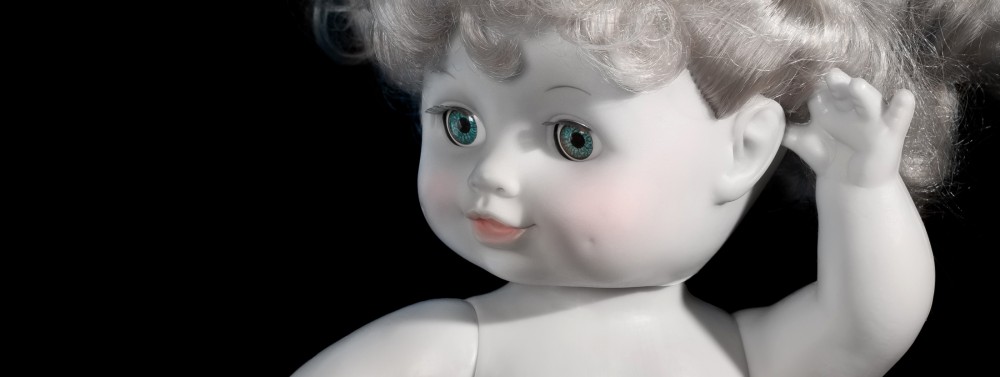
Doll 41


I started playing years ago with the purely human quality of anthropomorphization.  In particular, I’ve always been interested in inducing an anthropomorphic response in a viewer and then disrupting the response or having it fall away altogether.  If I do my job right (or am lucky), what remains for the viewer is the structure or mechanism of the effect.  This is the actual subject.
I get the ball rolling using posing and lighting techniques on subjects having built-in qualities I think I can control.  I exploit these subjects’ potential for looking alive, but then disturb that potential by exposing props and defects in the subject.  What I’m shooting for are certain qualities of confusion rather than a simple ‘gotcha’.  These confusions are springboards for our ability to add living qualities to inanimate objects and are foundational to human culture.  What’s difficult for me is bringing subjects to the edge of pain, happiness, ecstasy, even special qualities of human empty-headedness, without leaving the viewer with a sense that either the subject or themselves have been robbed of something or been unfairly treated.  The images should be mirrors of us.  I could use this human facility to make cheap shots, but I won’t.  This is a unique facility we humans should rejoice in owning.


March 24, 2013


Doll 43

by Gavin W Sisk

Gavin W Sisk

Doll 43

Hana has been putting up with my many trips to Goodwill to hunt for dolls to use for this project. She’s a little afraid I will somehow hurt the dolls. But they’re okay–so far.


March 23, 2013

My Rules

I’m an industrial photographer who sometimes accepts journalism asignments.
I was covering a townhall event some years ago and was trolling for a spot at the back of the auditorium for some long-shots of the Washington State govenor. I lucked into a sweet little pocket right behind the middle-last seats. As I set up my tripod a gravelly voice behind me growled, “Guy, my shot’s blocked!” I turned to see a cheap t-shirt not quite covering the hairy paunch of an unshaved camera operator from a local news crew. Other crews on my left and right had set up farther forward, but they all had dressed as if they had just left factory jobs to get to the event.  In my jacket and tie I stuck out–I didn’t meet code.
I’m a deferential kind of guy who avoids confrontation.  If one of the regular news photographers really needed to share my spot, and asked nicely, I’d have bent over backwards to make extra room. So I looked into the eyes of the hairy Buddha-belly guy behind me and replied, gently, “I guess you’re not in a good spot back there”.
I may not be a veteran photojournalist, but a fifty dollar tie has a few rights over a two dollar t-shirt.
Unlike the scruffy veterans, I was invited to meet and photograph the governor after the event.  They served me good scotch.

Oct. 31, 2012

Deviant Art

I sometimes wonder if creative thought isn’t just the anarchism of our synapses; and, by nurture or nature, works of art are the ad hoc quelling of neural insurrections. In that sense, art could be seen as the product of personal fascist juntas which we allow to beat  insurgent imaginations into the warp and weft of canvas, or regiment emotions into marks at risk of universal misunderstanding, or decode dissonance tight to a staff, or toss bodies gently in the wake of a whale’s dancing tail. They then leave us adrift: supine in a short, bright, cold silence, which we adore but know will kill us if we linger. Perhaps, to sleep, we shoot these little dictators, and raise new insurrections in our dreams.

Oct. 25, 2012

Parts is Parts

I do a lot of work as a bio-medical photographer, which is a sub-specialty of my general work as an industrial photographer for a large university and medical center. One of my duties is to photograph body parts (as well as body ‘wholes’).
Photographing a body part is easiest when the part is uncovered. This ensures the photographs will be useful to the doctor who ordered the photography. The more parts of a body there are to photograph, the more the body needs to be uncovered.
The most practical way to photograph many different body parts on one body (with live bodies, anyway) is to have the parts’ owner remove all of his or her clothing. So, imagine me standing in a locked exam room while holding a camera that’s wired to bright photographic strobe lights, and while wearing substantially more clothing than the only other person in the room. I see things.
Here are some interesting facts and observations relating to photographing naked people for medical purposes:

1. They don’t pay me well enough. I earn a hell of a lot more when photographing mannequins for Nordstrom.
2. Male patients do not at all like being photographed by a male photographer–which makes me wonder if homophobia is a hardwired gender instinct.
3. Female patients usually don’t care who photographs their parts–or which parts are photographed–as long as the work is done right. Female patients shake my hand and thank me; male patients retreat quickly to their dressing room.
4. All–ALL–distinguishing details of a patient’s body mysteriously disappear from my memory thirty seconds after I take their last photo. Really! I’ve run into female patients in the clinic lobby ten minutes after I’ve escorted them back to their dressing room, and I have not recognized them, even after they have said hello. (This does beg the question, why do they say hello to me in the clinic lobby?)
5. When I process and print the photos back at my office, I almost never recognize any of the patients.

Weird, huh? But when I compare notes with other male medical photographers and radiographers–even the good looking single males–they all report the same experiences. Nobody remembers anything.
So, there you go. Men really do have something on their minds besides sex. At least, some of the time they do.

July 7, 2012

Photography Redeveloped

By Russell Lee.  Reproduction from color slide. LC-USF351-317. LC-DIG-fsac-1a34096. FSA/OWI Collection. Prints and Photographs Division, Library of Congress

Russel Lee: Faro and Doris Caudhill, Homesteaders

My friend, Ed Farnham, sent me a link to an incredible collection of seventy color photographic images taken by american photographers working for the Farm Security Administration and Office of War Information.  The dates of these images range from the late Depression to the middle of World War II.  Thanks, Ed!  I recall seeing these images once before.  But they were mixed with other black and white images of that era.  It wasn’t until I reviewed this specific Kodachrome collection that I began to appreciate the significance of their effect on our generation.

These images help me to understand how the mechanisms that drive our perception of history, along with all its pre-conditioned conceptual and emotional responses, relate closely to how deep beneath our culture’s skin these documents appear to rest.  For example, in western culture we tend to relate qualities of color (even qualities of black and white) in visual media to points on a historical time-line.  We proceed to intuitively calculate the relevance, or lack of relevance, of a medium’s content to the context of our present lives.  As the color in an old photograph shifts and fades, much of its original context, subtext and intent begins a transmogrifying process of bleaching and redevelopment.  The pigment of its original DNA is gradually drawn away, and is often replaced, incrementally, by a sheen of culturally instituted meaning that allows us to proceed with our lives according to our immediate needs.  A faded, seventy-year-old, black and white photograph of a simply dressed homesteading couple is touching, but mostly serves us now by giving us the satisfaction that as time proceeds, our condition succeeds—the opposite of what cultural primitivism would assert as evidence of the inevitable decay of our society.

Ignoring cultural primitivism, most of us make use of a calendar to measure a culture’s forward progress.  So it is shocking to us when that same aged image is presented to us with evidence in full color that blood may still be coursing through the capillaries of this healthy couple’s tanned skin, and that the violent purple storm in the background seems to be passing harmlessly over their crops.  This isn’t just an interesting effect; it’s a potentially destructive effect!  This unexpected shift of the past toward the present could be quite threatening to both ends.  Those harmless clouds are suddenly the same ones that we hope won’t wash away Southern Pakistan this Fall.  At the same time, that quiet bag lady sitting on the curb outside our corner laundromat smoking a broken cigarette may have a story to tell us today that might not be properly interpreted from an archived digital image file viewed seventy years from now.

The candle burns at both ends.  When Rembrandt’s famous painting, ‘Night Watch’ was cleaned properly in 1940, it became the ‘Day Watch’.  And the fiction that time had infused into its darkened varnish dissolved without leaving a salable story in its place.  The painting was clean; but the Old Master’s status was smudged.  And consider how less menial Michelangelo’s personal sins became each time a new panel of the Sistine Chapel was restored during the last twenty-five years.  The newly revealed bright tones and intense colors threatened to insinuate the Renaissance’s timeline on top of our own.  Without cues from smoky hues, this masterpiece needs to work a little harder to compete for attention against fresher, cutting-edge continuous narratives.

The history of photography is relatively compressed.  But we quickly discern changes in its technologies, which we use as guides toward distilling and editing the contents and effects of the medium as it ages.  In the case of war images, Mathew Brady could accomplish more with a found body, in a few seconds, than his contemporary, Vasily Vereshchagin, could convey in his painting of a pile of skulls, produced over several weeks.  Vereshchagin’s work is masterful and important.  But Brady’s photo wins the day with an immediate sense of unaltered verisimilitude that makes no bones about its editorial intent.

Vasily Vereshchagin, Apotheosis of War, 1871 (right)

Mathew Brady: Death of A Sharpshooter / Vasily Vereshchagin: Apotheosis of War

Some of the original impact of Brady’s Civil War photographs has survived.  But our perceptions of imperfections in his era’s lenses and techniques have inured us to their full impact.  We’ve certainty seen work of better technical quality issued during each war that followed.  It seems that each new war’s delivery of images containing ever-higher levels of visceral verisimilitude has a degenerative effect on the power of images from previous conflicts.  At the height of World War II, Life Magazine needed to remove details of maggots on a photograph of a dead US soldier’s body to make it suitable for public consumption.  Years later, when the magazine chose to republish the image, it realized that the maggots needed to properly repopulate the dead body before the photo could carry anywhere near its original impact.  This was the Viet Nam war era, when color photography was making its first impact on printed publications.  Black and white maggots from Iwo Jima had lost their impactful place in history.

Our diet of photography has been prepared, for the most part, by printed media, cinematography and our family camera.  Though color film and processes have been available since the early nineteen hundreds, it was expensive and fussy for amateur photographers, and expensive and impractical to reproduce in printed media and movies.  Television took even longer to accommodate color in their productions.  Most of us who are middle-aged rely only on our memories of color while we pore through photo albums of our childhood.  I know from a black and white photo from my youth that it was my father’s green 1952 Chevy sedan that I was leaning against when I was five years old.  And it looks like I posed for that Brownie snap even longer ago than it feels.

So, the government accountants must have howled until sunup when they received the first bills for purchasing and processing all those rolls and plates of very expensive Kodachrome film.  In the middle of a national financial crisis, it was a mistake as obvious as thousand-dollar toilet seats and crates of gilded goblets.  Without any other comparable, contemporary media context, the color must have seemed garish and absurd—even to some of the photographers who were assigned to use it.  Only a handful of photographers and assignment editors, along with perhaps even fewer astute and dedicated editors and bureaucrats, could envision more than a slim relevance of these color images to their place in history.

Eighty years later, we’re dealing with the same shock.  How can these color images represent a time and status quo that we believe we have since evolved from?  How are our storms less ravaging?  How are our poor less needy?  How are our war-dead less disfigured and bloody?  What is the real shape of industry’s progress?  Old barns still are red.  A girl in a pinafore dress looks the same riding on a buckboard as she does sitting in the back seat of a Mazda.  Some folk still work hard all day; some still don’t work at all.

Unintentionally, perhaps, the mundane is suddenly elevated as art.  Most importantly, the present suddenly owes a larger debt to the past.

Oct. 20, 2010