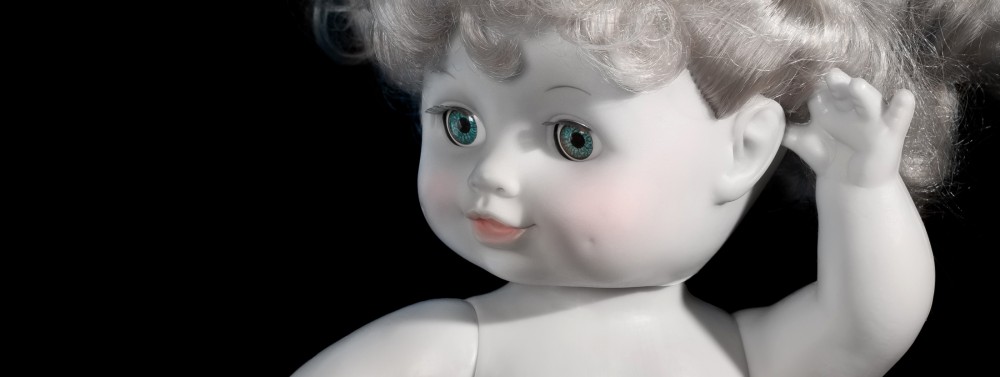
Parts is Parts

I do a lot of work as a bio-medical photographer, which is a sub-specialty of my general work as an industrial photographer for a large university and medical center. One of my duties is to photograph body parts (as well as body ‘wholes’).
Photographing a body part is easiest when the part is uncovered. This ensures the photographs will be useful to the doctor who ordered the photography. The more parts of a body there are to photograph, the more the body needs to be uncovered.
The most practical way to photograph many different body parts on one body (with live bodies, anyway) is to have the parts’ owner remove all of his or her clothing. So, imagine me standing in a locked exam room while holding a camera that’s wired to bright photographic strobe lights, and while wearing substantially more clothing than the only other person in the room. I see things.
Here are some interesting facts and observations relating to photographing naked people for medical purposes:

1. They don’t pay me well enough. I earn a hell of a lot more when photographing mannequins for Nordstrom.
2. Male patients do not at all like being photographed by a male photographer–which makes me wonder if homophobia is a hardwired gender instinct.
3. Female patients usually don’t care who photographs their parts–or which parts are photographed–as long as the work is done right. Female patients shake my hand and thank me; male patients retreat quickly to their dressing room.
4. All–ALL–distinguishing details of a patient’s body mysteriously disappear from my memory thirty seconds after I take their last photo. Really! I’ve run into female patients in the clinic lobby ten minutes after I’ve escorted them back to their dressing room, and I have not recognized them, even after they have said hello. (This does beg the question, why do they say hello to me in the clinic lobby?)
5. When I process and print the photos back at my office, I almost never recognize any of the patients.

Weird, huh? But when I compare notes with other male medical photographers and radiographers–even the good looking single males–they all report the same experiences. Nobody remembers anything.
So, there you go. Men really do have something on their minds besides sex. At least, some of the time they do.

July 7, 2012

Time and Time Again

When you look back on your life, do you wonder if you were different persons during successive life passages?  While recalling your addled adolescence, can you recite your name without feeling surprised at how ill fitted it is to your history?  Are sepia-toned memories all you keep of learning to ride a bike, understanding fractions, arguments with your parents, your first kiss?  Does your present feel as far removed from your past as it once was from your future?  Have you left behind a light, immortal avatar of yourself perched on a thin branch at the top of a tall tree? 

 
       Then

days i breathed from the treetop
                                    swinging deaf to gravity and
                                  singing slights to minor keys
                        i cared not what i couldn’t do
           and didn’t know how to stop.

                                               
                                               June 2012


Pressing Statistics

I’ve been reviewing readership statistics for my blog site. This is what the numbers seem to say–

If I post a blog on a Monday, it won’t be read until the following Saturday.
If I post something semi-clever and apolitical (mostly), I’ll receive positive comments on Facebook.
If I post something overtly intellectual (okay–pseudo intellectual), I’ll receive positive comments and referrals via WordPress.
If I post poetry, I get comments and referrals from everyone, as well as invitations to join various writers’ groups. This despite the fact that I usually don’t post my best poetry.
If I put a lot of effort into a blog, few people will read it, and fewer will comment.
If I barf up two hundred barely readable words in ten minutes and nonchalantly post it, everyone will read and like it, and Askimet will work overtime to screen out all the barely readable comments by nuts.

So, what does all this suggest? I don’t know. Maybe, don’t think too hard on Monday, and don’t make people think too hard on Saturday. Or maybe, just keep writing and posting, and infer nothing from statistics. I mean, what the hell–it’s not like I get paid for any of this.

June 27, 2012

What?

I visited Goodwill this evening to buy some toy dolls (another story; but trust me, I needed some toy dolls). Ahead of me in the checkout line was a baggy old man wearing baggy old clothes and a beat-up set of headphones.
When the cashier finished ringing up the old man’s purchase, she told him the total, “Four dollars and ninety-two cents, please.” The old man asked, “What?” The cashier repeated the price. The old man put his left hand near his left headphone and again asked, “What?” The flummoxed cashier again told him the total, “Four dollars and ninety-two cents,” but said it more loudly, leaving out the ‘please’. The old man, appearing frustrated, pulled the left headphone away from his ear and again asked, “What?” Once more the cashier told him the total, “Four dollars and ninety-two cents.”
At this point the old man let the headphone snap back over his left ear and said to the cashier, angrily, “Well, why didn’t you say that the first time!”. He then began to slowly and carefully rummage through his baggy old clothes in search of his wallet, which he finally found in a very strange place, the back pocket of his pants.
Convinced I had been teleported back to the 70’s and Allen Funt was still alive, I looked carefully around the front of the store for hidden cameras. I expected an assistant producer to walk up and hand me a pen and a model release while a TV crew with cameras and sound equipment rushed me from nowhere. No such luck.
What a shame. I would like to have lived through the Seventies again. It may have been a boring decade, but it seemed to last forever. That’s a big plus when you hit your Fifties.

June 26, 2012

Which Why and Where the Wars We Wage

I looked up my draft number yesterday.  An uncomfortably low 129.  That surprised me; my memory had it higher than 270.  However, because no kids were actually inducted into the military in nineteen seventy-four, the year I became eligible for the draft, I had little to worry about.  Though Saigon had not yet fallen, American military involvement in Viet Nam had just ended and our troops were returning home.  The draft was a moot point.  Never the less, it seemed like a good idea to tune into the process.
I watched the draft lottery on my family’s old black-and-white TV.  The whole thing seemed like Bingo night at the parish hall except that no one yelled out that he had won.  I must have felt anxious; I don’t recall exactly.  I know my mother was worried, even though she had already worked out all the angles for keeping her three sons out of whatever conflicts were on the horizon.  Youth and stellar school grades protected my younger brother.  For my older brother, my mother planned pre-med school.  For me, her hope was that the Army would classify me as 4-F, meaning I would be found physically unfit for military service due to a somewhat embellished medical history.  I guess she could not count on my academic performance.
I had no personal angle on avoiding military service.  For the most part, I had been against our country’s involvement in the Vietnam War, but I didn’t waste much thought on dodging the draft.  Maybe I had mixed emotions about my obligations to my country.  Maybe I was afraid of dying young.  Maybe I would be ashamed of ducking my duties instead of bullets.  Maybe I was afraid of pulling the trigger on another man’s life—or worse, discovering I was proficient at it.
Mostly, my emotions were too muddled to count as mixed, if that can make sense.  Who wants to die young?  Who really wants to live forever?  Who does not want to be completely free?  Who does not believe they owe some form of dues to the society they are sewn to?  Who does not want what they only want right now, without regard to the future and forgetful of the past?  Who does not want to just get high on some magical ingredient—religion, philosophy, chemistry—and be altogether ignorant of time?
So, I missed the war–or rather, the war missed me.  It ended too soon to matter to my life except as a subject of conversations about ‘almosts’.  To my hawkish friends I could promise I would have done my duty.  To my dovish friends I could describe which route I would have taken into Canada.  To myself I could imagine being a buck-private in a foreign country, bravely crawling through overlapping fields of fire on my way to breakfast.
In truth, I would have never made it to breakfast.  I have always lacked what military people call S.A., or, Situational Awareness.  On my first morning of deployment in the field, I would have stood up in my foxhole to stretch, and immediately have been dissected by a mortar round.  As in Randall Jarrell’s poem, ‘The Death of the Ball Turret Gunner’, they would have washed me out of my hole with a hose.
So it goes.  You survive birth, though you really aren’t well designed for it.  You survive running with scissors.  You survive hurtling your car at high speed toward other cars with nothing to keep you alive except a collective faith in feint yellow lines painted down the middle of the roads.  Then, after surviving all this, while you are happily feeding pigeons in the park, you might be killed instantly by a falling piece of space junk.  It makes no sense.  However, is it unfair?  Is this worse, for example, than news that a lump on your liver has been diagnosed as your body’s cells fighting a war to end all wars—and worse than accompanying news of your calculable expiration date?  Somehow, it must make sense.
Knowing your expiration date might make it difficult to enjoy feeding the pigeons.  It could require a re-evaluation of life—yours and others’.  It certainly asks for appreciations of the facts that, around here, you are free to choose how well or badly you face your expiration date, and that this freedom is partly paid for by people who intentionally risk their own future opportunities to feed the pigeons by volunteering to sit in foxholes.

May 28, 2012

Not All Vacuums Suck

I often roll my eyes (subtly, I hope) as I listen to people report their fears of modern technology.  Much of what I hear is unorganized repetition of myths.  However, the rolling of my eyes is usually the most I dare offer to these conversations.  I believe that many of these fears and complaints simply reflect nature’s abhorrence of both physical and metaphysical vacuums.  Naturally, we humans need to fill in the blanks.  There isn’t much point in being human otherwise—or much fun.  Our abhorrence of vacuums fills both cradle and grave.  Therefore, I try not to claim I’m above menial irrationalities.  And it would be a lonely argument anyway.
I recently purchased a new microwave oven from Sears.  Its predecessor had degraded from a useful appliance capable of destroying frozen lasagna in minutes to something that wouldn’t keep a hamster warm.  I don’t like cooked hamster, but I do enjoy other food substances when served and eaten in a hot-ish state.  This means a good microwave oven is at least as important to me as my refrigerator.  In my galley kitchen, the microwave oven is conveniently located to the right of the sink, plugged into a dedicated circuit.  In my house, the only other devices that rate dedicated circuits are the stove, the furnace, and the computer.
The most dangerous object in my kitchen, I’ve always assumed, is my boning knife.  But since I’ve been using this new oven, I’ve been experiencing horrible headaches and eye-strain in the evenings.  Allergies, I thought.  Then this evening, while I was working at the sink, I turned my head to look at the new oven as it was heating some frozen chicken strips.  While I was griping to myself about another headache setting in, I noticed that I could see into the oven through a thin gap in the door’s hinge.  It turns out the front of the oven is misassembled!  Even worse, because of where the magnetron is located inside the oven, any leaking microwave energy is likely aimed exactly where I stand while I’m working.
Like any vacuum-abhorring myth builder, I went straight to the internet to search for ‘facts’.  It turns out that microwave oven facts and myths are a challenge to sift through.  Who knew that Nazi scientists designed these devices as weapons, or that their use is unregulated and commercialized only in countries with capitalist-controlled governments (apparently, this has not been satisfactorily proven by such governments to not be true).  It turns out there is some agreement between various lists of symptoms of exposure of humans to various types of microwave energy.  At the top of the list is elevated temperature of affected tissues (duh!).  Listed among common neurological symptoms of exposure to microwave energy are headaches and eyestrain–though the physiology is not well understood.
How much physiology about my headaches do I really need to understand?  I don’t have an instrument for quantifying and qualifying the presence of leaking microwave energy.  I also don’t have an instrument for measuring the presence and effects of various allergens in my home.  I certainly don’t have an instrument for measuring the presence of vacuums in my head (my old blogs not withstanding).  Nonetheless, that new microwave oven is going back to Sears tomorrow.

April 11, 2012

The Meat of the Matter

Lately, I’ve noticed some tabloid posts that have attempted to champion meat-eating diets by contrasting shrewdly edited photographs of meat-eating and vegetarian celebrities.  The implications are irrational; but that doesn’t matter to the editors or their readers.  Readers rather infer a fib than reason a riddle.  Or rather, nonsense makes hotdogs easy to digest.  But I digress.
These posts have focused especially on photos of two particular middle-aged women, nutritionist Gillian McKeith and TV cook Nigellea Lawson.  I don’t get quite the same vibe from this match-up that the tabloids intend.  I already know that McKeith’s views don’t really represent those of most other nutritionists—even of many vegetarians and vegans.  Isn’t this just a case of placing the worst sample of one particular, peculiar life-style next to the best sample of a life-style that is more conventional?  McKeith might be in even worse shape if she followed a different diet.  Who knows?  Though she would certainly look better in front of good lighting and a friendlier photographer.
Nigellea, on the other hand, doesn’t look good just because she eats meat, butter, and desserts.  She looks good because she has a savvy fashion consultant, a fitness coach, a shrewd publicist, great genes (esthetically speaking), financial security, and a knack for showing up in front of the right cameras at the right times.  She can include meat, butter, and dessert with her vegetables because she exercises and has a healthy sense of moderation.  She also is intelligent, capable, and driven and has a bright and confident personality; but that doesn’t matter to most men (nor many women).
McKeith and Nigellea are both statistical outliers.  If they traded lives, they might change looks—but they wouldn’t trade looks.  No woman will ever look like Nigellea just by including meat, butter, and desserts in her diet.  And who’s to say Nigellea would look any worse if she followed a sensible vegetarian diet.  Hell, she might even look better!  Looking better is what this is all about, isn’t it?
Or is it?  It’s a shame we work so hard to parse the regimens and ingredients which should comprise ideal beauty in women, only to leave a default list which defines what seems to make other women ugly.  We work badly at this.  And it’s more than a shame.  I don’t mean to seem patronizing—as a man, I know that it isn’t just women who have to deal with this.  I also know that most normal women and men wouldn’t mind at all if others thought of them as beautiful or handsome.  I wouldn’t mind.  But women and men each have to deal with this differently, and with different consequences for not matching certain ideals.  Worse is that we all like to think we’ve seen the light (we really have!), and we promise to change (we really will!), but we do little (really, very little).
I’m not surprised.  I’ve seen the light—burned onto my retinas by my laser-wielding mother.  She meant the best for me.  But did you notice I’ve referred to Ms. McKeith by her last name, and Ms. Lawson by her first?  That mistake was a genuinely accidental deference to Nigellea’s physical beauty.  Obviously, something inside me desired to be on a first-name basis with her.  I make apologies and promises, yet I commit the same old sins every day.  Those tabloids know their audience.  If this is our only nature, we’re doomed.

Dec 17, 2011


A Step Up?

For two years I’ve been using my smart-phone for nearly all of my writing. Small thoughts, small screen–it’s been a good fit. My smart-phone’s easy accessibility also syncs well with my unpredictable and fragile trains of thought. And though some people might claim I sometimes write too much about too little, I appreciate how helpful this tiny format has been for learning to think and write more economically. Those people should be thanking my phone.
Until six months ago I could read my phone’s tiny text without glasses. But the strain of it has finally caught up with me, and everything has become blurry. I have strong bifocal glasses now, which help a little. I also now keep cheap reading glasses scattered around the house. But even while wearing strong glasses, my eyes become so strained after just thirty minutes of writing that they won’t focus on anything at all for another thirty minutes. On top of problems with focus, I’m also experiencing problems with double and quadruple vision. As a professional photographer, that is especially frustrating.
I have surrendered! Thanks to a generous cash gift from my wife, Tami, I’ve been able to order a small, inexpensive notebook computer to take the place, mostly, of my smart-phone. It will be interesting to see if the quality of my writing changes with an increased screen size. At least I won’t have to constantly retype what my thumbs are too fat to get right on my phones’s tiny virtual keyboard. Now I just need to learn to work with a Windows computer and integrate it into a Mac household. I may also need to sew eleven-inch pockets to the backs of all my pants.
Aren’t you all glad I’m not a proctologist?


Nov. 26, 2011


Jobs Well Done

We’ve been calling this the Computer Age.  But computers just chew data and convert it to sugar and waste (as far as we can judge the difference).  Garbage in; garbage out.  For centuries we’ve gladly paid for garbage from exclusive producers.  Whoever owned a press also owned a piece of culture.  Now we make our own garbage, and gladly pay for it.  This is the Content Age!

“Pa!  The roof and the pigs and all the corn have spun up into a white tornado!  Shouldn’t we go in after them?”

Seeing that a few billion of us chimps have recently acquired magic typewriters, I suppose we could hope and work to see something good come of it.  Steve Jobs died trying.


Oct. 5, 2011